|
|
SOLENIDAE |
|
|
Click on an image to enlarge
|
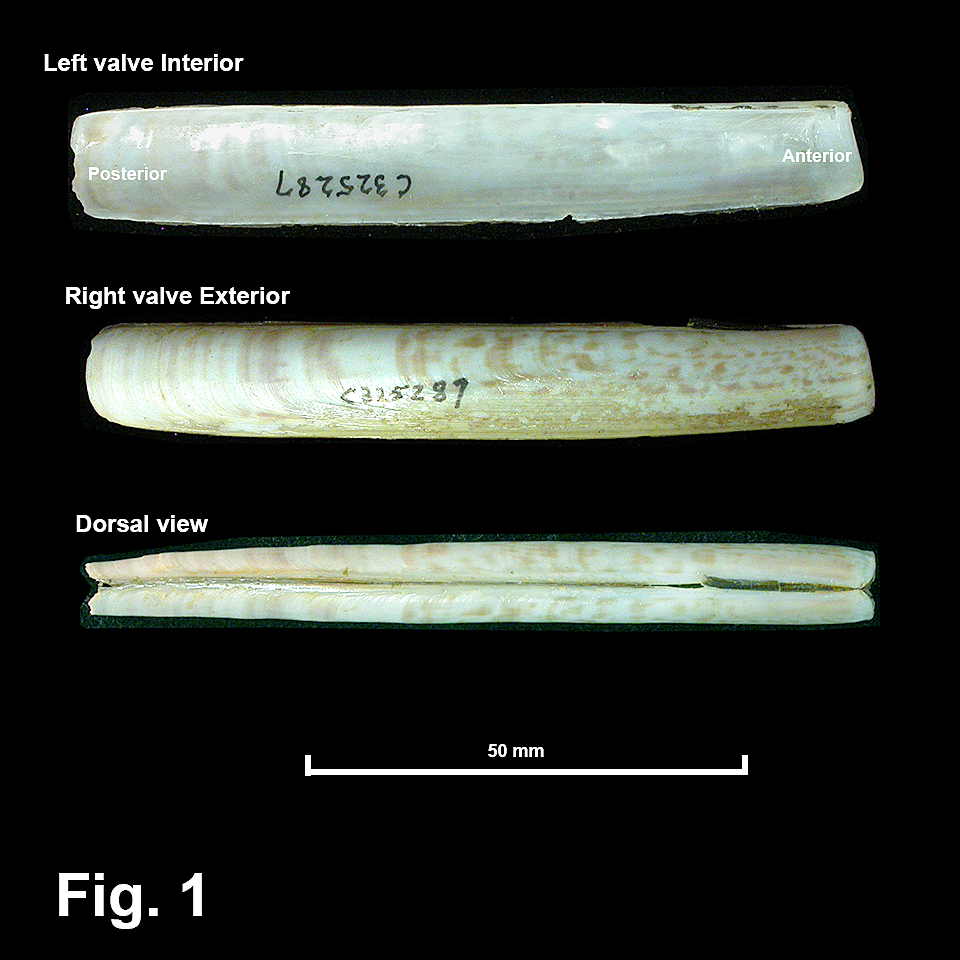
Solen vaginoides Lamarck, 1818 Description: Shape very elongate, straight or slightly curved, gaping at both ends. Exterior smooth. Interior with anterior adductor muscle scar very long, posterior scar about half as long as anterior scar. Pallial line clearly defined, pallial sinus deep. Hinge at anterior end, with one strong cardinal tooth in each valve, laterals absent. Ligament external, at anterior end, about one-sixth of shell length. Shell exterior white with curved pale brown lines or blotches; interior white. Periostracum thin, smooth, brown. Size: Up to 102 mm in length. Distribution: Endemic to Australia: central Qld, southwards and around southern Australia, to WA, including Tas. Several undescribed or recently described Solen species occur in northern Australia (e.g. Solen darwinensis von Cosel, 2002); these were confused with S. vaginoides causing its range to be incorrectly extended northwards by some authors. Habitat: Lives buried in sand in sheltered inlets, with the short siphons extending up to clear water. Cotton (1961) described the behaviour in South Australia:
According to Willan (1998: 341) quantities of Solen vaginoides are dug as bait for bream fishing in harbours of south-eastern Australia; it is said these bivalves can be enticed out of the sand by a pinch of salt. Synonymy: This species outline varies from straight to slightly curved; Iredale (1924) named the slightly curved form Solen correctus Iredale, 1924, but there is continual variation from straight to curved specimens. Additional established synonyms are Solen aspersus Dunker, 1862, Solen philippianus G.B. Sowerby II, 1874, and Solen pictus Clessin, 1888. Fig. 1: Gunnamatta Bay, Port Hacking, NSW (C.325287) |
|