|
|
PHARIDAE |
|
|
Click on an image to enlarge
|
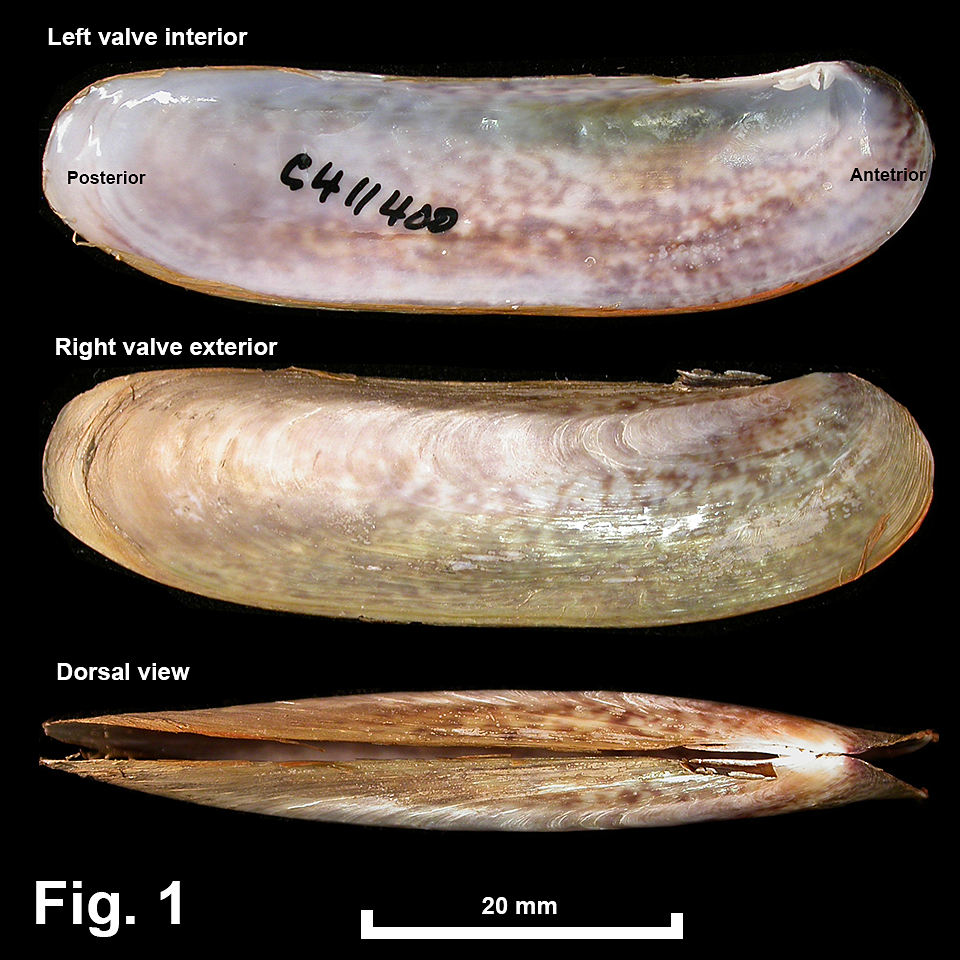
Ensiculus cultellus (Linnaeus, 1758) Description: Shape very elongate, curved, gaping at both ends; umbo and ligament near anterior end. Exterior smooth. Interior white with external colour showing through; anterior muscle scar long and narrow, posterior muscle scar shorter. Pallial line and pallial sinus clearly defined. Hinge at anterior end; right valve with cardinal tooth and one lateral present as erect plates, left valve with matching slotted pairs of teeth. Ligament external, at anterior end. Shell exterior white mottled with purple spots and bands. Periostracum thin, smooth, brown. Size: Up to 80 mm in length. Distribution: Tropical Indo-West Pacific, including northern Australia. In Australia, from Shark Bay, WA, around the northern and eastern coastline, to Port Hacking, NSW. It was recorded from the Mediterranean Sea a decade ago (as a Lessipsian migrant through the Red Sea), but it seems not to have established. Habitat: Lives in sand from low tide level to about 50 m. Common in the tropics, uncommon and increasingly rare towards the end of range in NSW. Synonymy: There is an unresolved controversy over the number of species of Ensiculus. Based on shells alone, some authors suggest E. cultellus is the only species in the Indo-Pacific Ocean, whereas others, such as Huber (2010), consider there are four valid species, only one of which - E. australis (Dunker, 1862) - occurs in Australia. If this is the case, then that would be the name for the species dealt with here. Ensiculus hilaris Iredale, 1936 is also a synonym for the Australian species, based on fossil specimens dredged from Sydney Harbour by the dredge Triton. Fig. 1: Fraser Island, Qld, offshore of Sandy Point, south of Moonan. (C.411400) |
|