|
|
MACTRIDAE |
|
|
Click on an image to enlarge
|
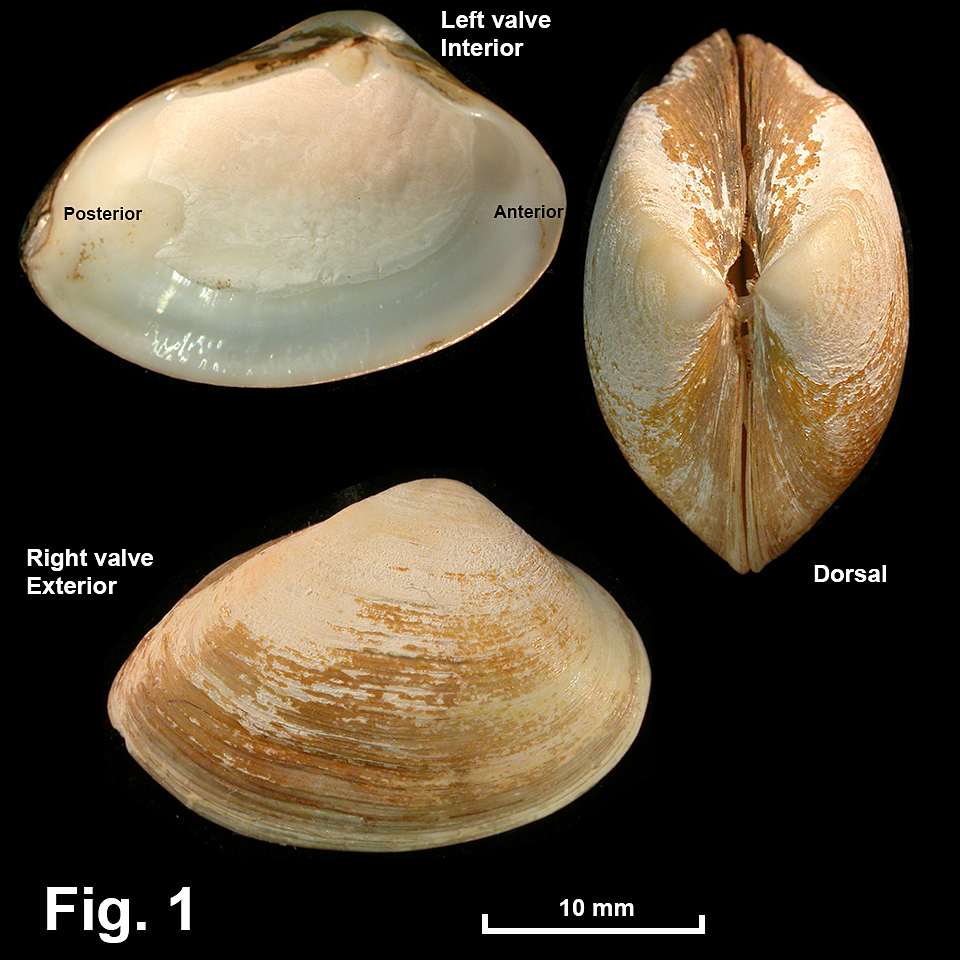
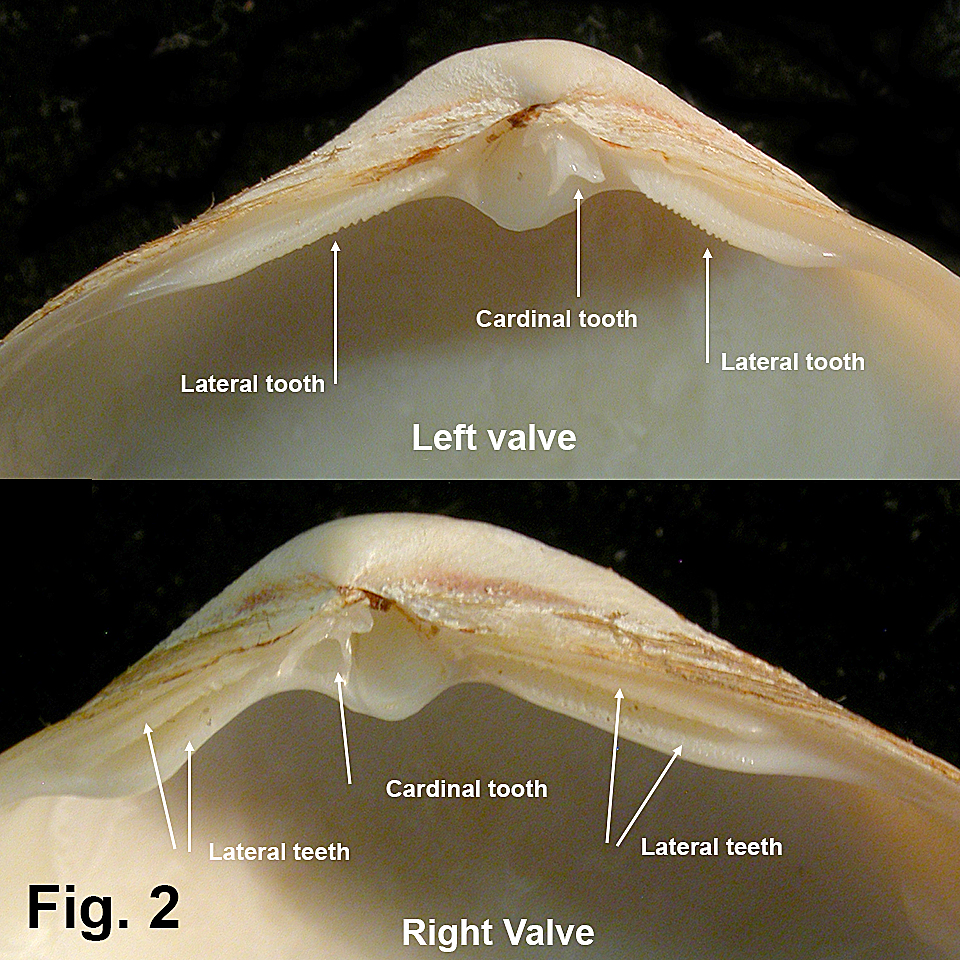
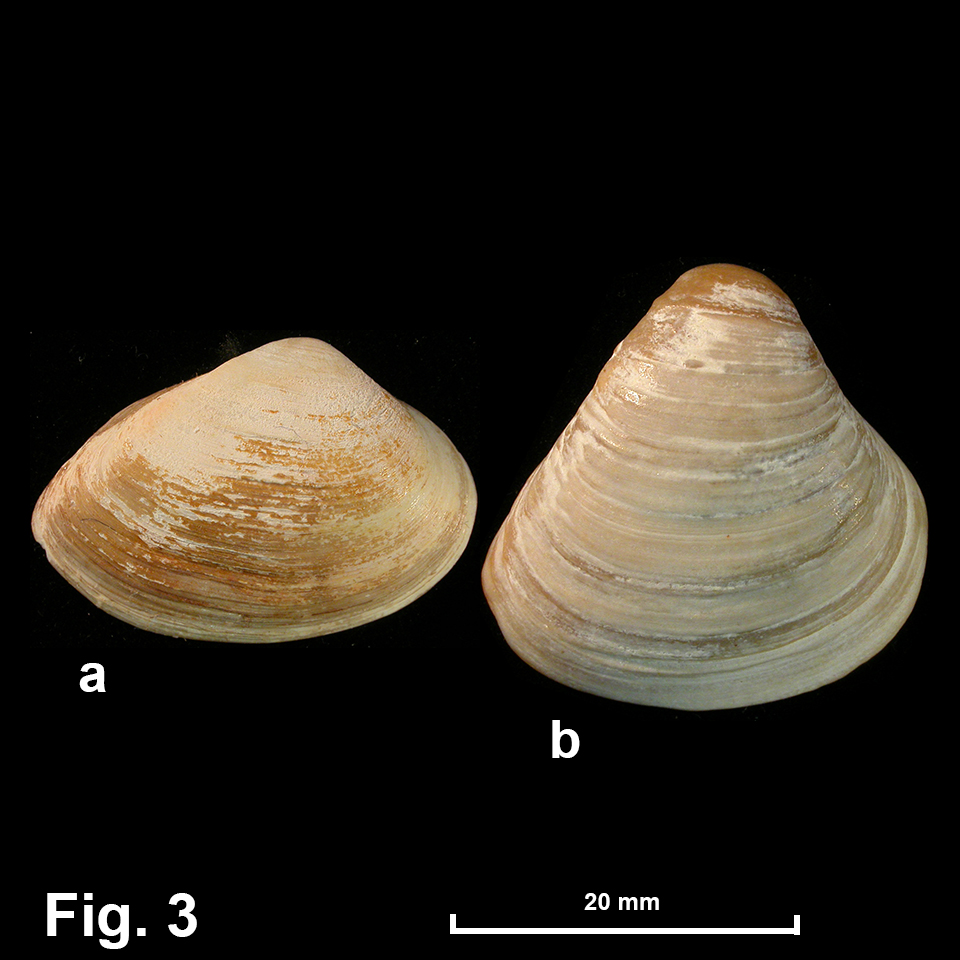
Spisula trigonella (Lamarck, 1818) Description: Shape extremely variable (as shown in Figs 1-3), some shells much longer than high (Fig. 1) whereas others are almost equal in length to height (Fig. 3). Umbo in front of midline ; ridge from umbo to postero-dorsal margin. Exterior usually eroded, sculptured only with commarginal growth lines. Interior white, muscle scars and pallial line distinct; pallial sinus shallow. Hinge (Fig. 2) Same plan as the family, but lateral teeth strongly ridged (a character of the genus Spisula). Ligament internal. Shell white, with eroded brown periostracum. Size: Up to 30 mm in length. Distribution: This species is presently considered to occur around the entire Australian coastline. It has long been recognised as common in southern Australia, but shells exactly matching southern S. trigonella (but consistently smaller) are now recognised as common in parts of northern Australia (R. Willan, pers. comm). It is a relatively recent introduction to southwestern WA, being documented as newly occurring in the Swan Estuary, Perth, by Wilson & Kendrick (1968). Genetic research is required to clarify the distribution and could reveal a species complex. Habitat: Lives burrowing in sand or mud in sheltered coastal waters and lower and middle reaches of estuaries. Synonymy: The large variation in shape has resulted in many synonyms, which are well documented elsewhere (ALA, WoRMS). Of these, the most recently used of the 19th century synonyms in NSW literature are Gnathodon parvum Petit, 1853 and Spisula cretacea Angas, 1867. More recently, Spisula colganae Healy & Lamprell, 1992 was described from the Gulf of Carpentaria, but is considered a synonym of S. trigonella by WoRMS on the assumption that S. trigonella has a pan-Australian distribution. Remarks: The life history and population biology of this species in the Hawkesbury River, NSW, was described by Jones & Murray (1988). The animal occurred living in situations of full marine salinity and upstream to salinity of 12%. Spawning usually occurred between August and November, and growth rates were highest over summer, between November and February. Fig. 1: Iron Cove Creek, Port Jackson (C.083298) Fig. 2: Hinge detail Fig. 3: a. Iron Cove Creek, Port Jackson (C.083298) b. Graving Dock, Wooloomooloo, Sydney (C.314885) |
|