|
< Previous family introduction |
|
|||||
|
|
Family Mactridae Surf Clams or Trough Shells
|
|||||
|
The Mactridae is a large family, consisting of at least 180 species (Huber, 2010), of medium to large sized shells, which occurs worldwide in tropical and temperate regions. There are about 40 species in Australia, mainly in the tropical north, and 10 species in NSW. Mactrids live mainly in the low intertidal and shallow subtidal zones, with NSW species generally living at less than 50 m depth. Their habitat is sand or sandy mud, on open coasts or on sand flats in bays and harbours. Species have been found in the lower and middle reaches of Sydney Harbour and on the sand flats of Gunnamatta Bay, Port Jackson, although this later population is much decreased due to dumping of dredgings. There is one species in NSW that has an exceptional habitat, Spisula trigonella, which lives in the lower and middle parts of estuaries, and is found in abundance in Sydney Harbour and well up the Hawkesbury River estuary. Of the 10 species of Mactridae known from NSW, nine are restricted to Australia, with the other being a species that occurs throughout the Indian Ocean and Western Pacific region. Of the Australian species, some, such as Austromactra rufescens, have the usual temperate distribution of southern Queensland southwards and around southern Australia to southwestern WA, while the others are restricted to eastern Australia. As with other bivalves, mactrids feed by extracting minute particles of organic matter from the flow of water that they draw in over their gills. There are two united extensible siphons at the posterior and of the animal, one inhalant and one exhalent. The animals live vertically in the sand or mud, with the siphons extending above the substrate into clear water. The presence of the siphons is reflected in the shell interior where a pallial sinus marks the line of attachment of the siphonal withdrawal muscles. Family Reference The Australian species were catalogued by Lamprell & Whitehead (1992). Coverage In additional to the species detailed here, the following have been recorded from NSW:
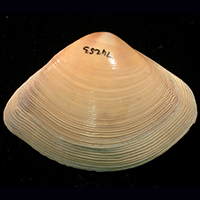
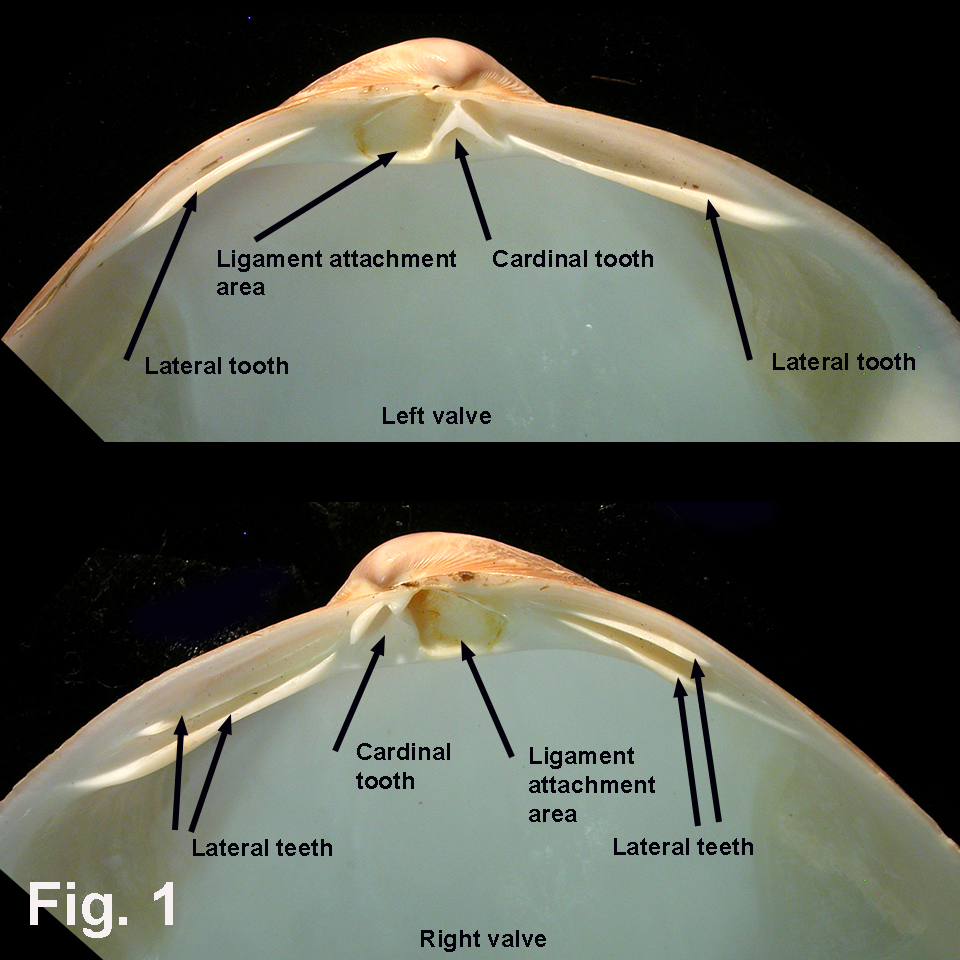
Identification Notes Shell form Medium to large shells from 14 mm up to 120 mm in length, with shell fairly smooth or with weak commarginal sculpture. Hinge There is a characteristic inverted V-shaped cardinal tooth in the left valve and a matching but smaller cardinal in the right valve (Fig. 1). There are lateral teeth in both valves - single blade-like laterals in the left valve and matching slotted laterals in the right valve. The ligament joining the valves is very distinctive in mactrids. It consists of a small to obsolete external section plus a large spoon-shaped internal section that fits into a special socket (a resilifer, or a chondrophore if it projects into the valve below the hinge, which is usually the case) that lies immediately under the umbo and so separates the cardinal teeth. Shell interior Two adductor muscle scars are usually apparent. The pallial line shows a large indentation posteriorly where the siphons are accommodated when they are withdrawn. Fig. 1 Mactridae hinge structure (Mactra eximia, DLB5706)
|