|
|
MACTRIDAE |
|
|
Click on an image to enlarge
|
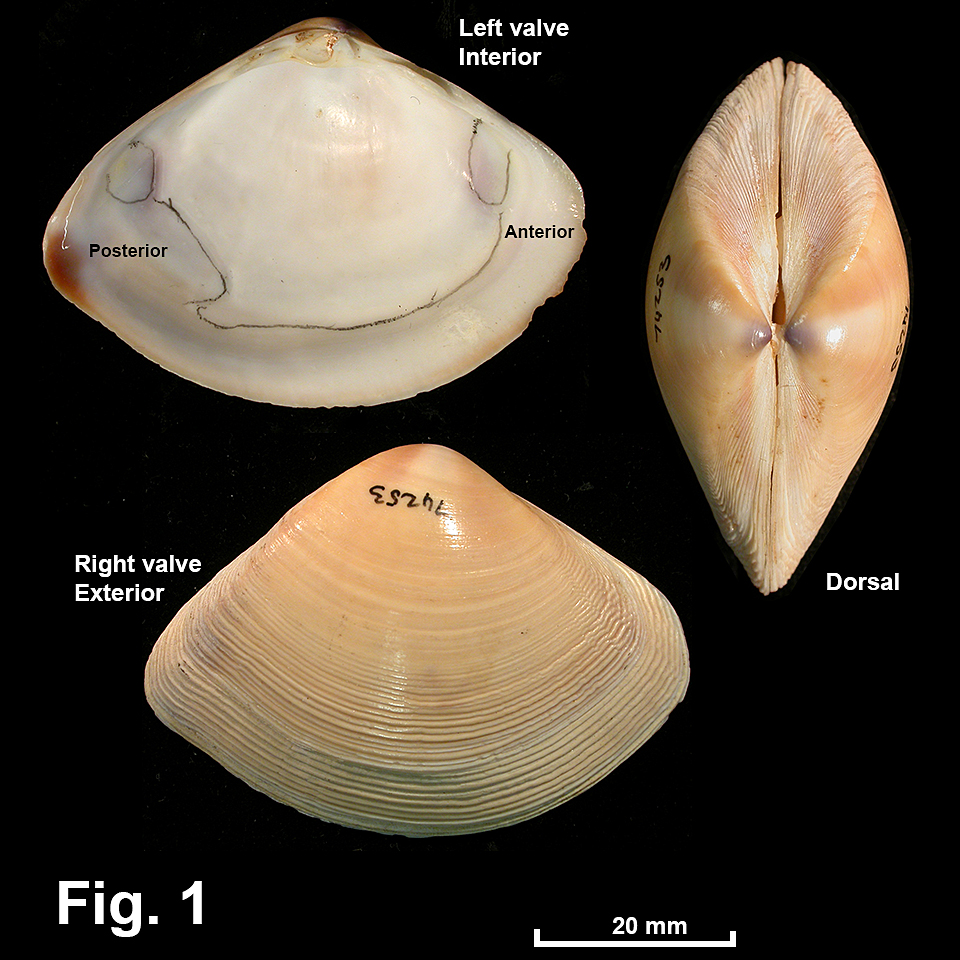
Austromactra rufescens (Lamarck, 1818) Description: Shell lightweight when juvenile, solid and heavily when adult. Shape elongate, postero-dorsal slope straight, antero-dorsal slope weakly concave, ventral margin rounded anteriorly, angled posteriorly. Exterior smooth dorsally, developing strong irregular commarginal ribs ventrally; these ribs wavy at extremities. Interior with pallial line and muscle scars well defined, margin smooth; interior callus thickening with age, initially thin and mainly purple, becoming thick and mainly white with maturity. Hinge as for family. Ligament internal. Shell fawn or pale brown, umbo purple with central radial white streak. Size: Up to 67 mm in length. Distribution: Endemic to Australia: Yeppoon, Qld, southwards and around southern Australia, to southwestern WA, including Tas. Cotton (1961) extended the range in WA as far north as Shark Bay. Habitat: Lives in sand and sandy mud in the shallow subtidal zone of ocean beaches. Often washed up on beaches. Common. Synonymy: Over the wide range of this species from Western Australia to Queensland there is variation in the strength of the sculpture and in shell shape. Shells from NSW were considered to be flatter and more elongate than those from further south, and were called Mactra contraria Reeve, 1854. Particularly elongate shells from southern Queensland were named Austromactra caloundra Iredale, 1930. Remarks: This species changes character with growth from juvenile to adult. When juvenile, the shell is lightweight, with the interior splashed with purple. However, as they grow shells develop a callus internally, with adults being moderately heavy with the interior callus thick and white. Fig. 1: Hyams Beach, Jervis Bay, NSW (C.074253) |
|