|
< Previous family introduction |
|
|||||
|
|
Family Donacidae Wedge Shells
|
|||||
|
The Donacidae is numerically a medium-sized family
of bivalves which live on open coast sandy beaches. In NSW there are
only three species, Australia-wide there are seven species, and worldwide about 100 species (Huber, 2010). Wedge shells are prominent in the surf zone in NSW
where they burrow shallowly and are often washed out by waves. They are
fast burrowers and can rapidly re-burrow when dislodged from position.
They are a prominent component of coastal fauna, often so abundant that
they are collected for food or bait. Family Reference The Australian species were documented by Lamprell
& Whitehead (1992). The present work builds on that treatment by
updating the nomenclature and synonymy. Coverage The three species that occur in NSW are detailed
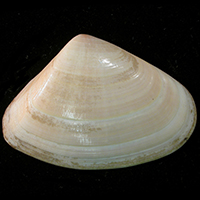
here. Identification Notes Shell form Wedge shells are generally described as triangular,
which is so for two of the three species in NSW, but the third is so
elongate that the triangular form is not the dominant character. Shells
are solid, with weak sculpture with thin or absent periostracum and
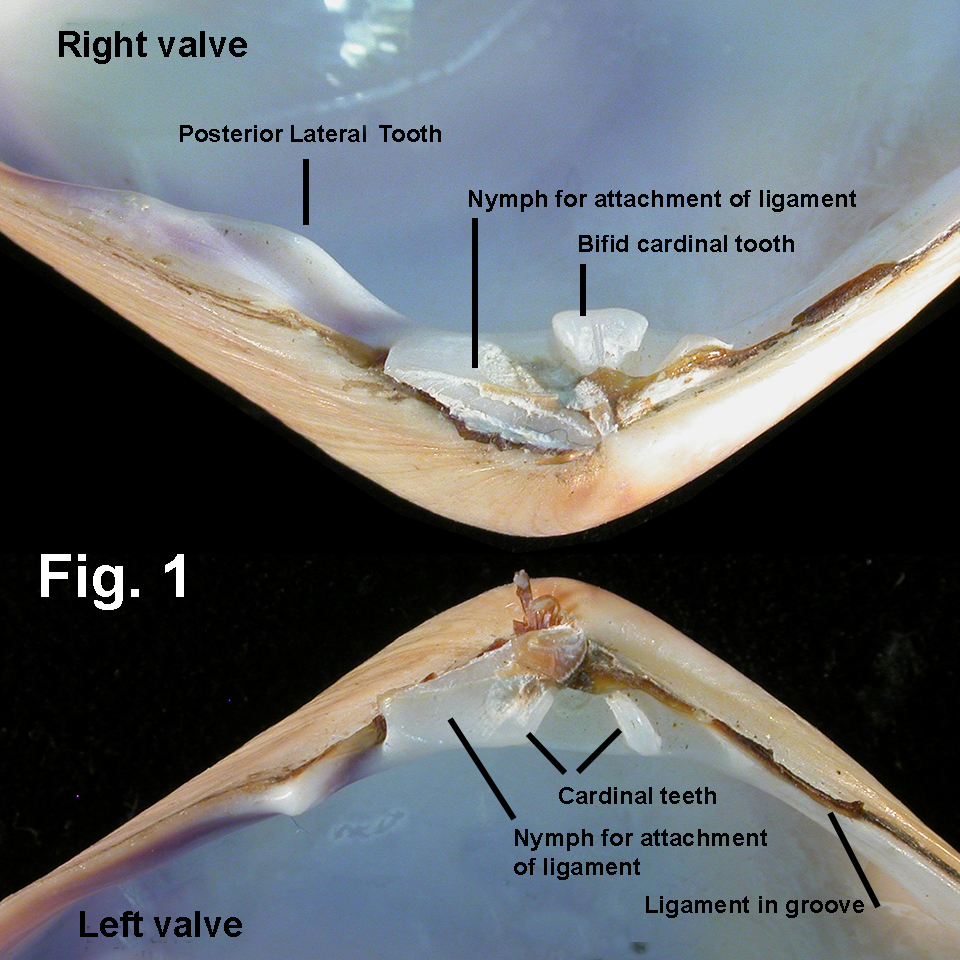
muted colouration. Hinge and ligament The hinge of Latona deltoides is shown in Fig.
1. In the right valve there
is a massive, bifid cardinal tooth that fits between two much smaller
cardinals in the left valve. Beside the cardinal teeth there are
nymphs to which the ligament is attached; the nymphs are separated in
the right valve but joined to the cardinal tooth in the left valve. Widely
separated lateral teeth are present in both valves. The ligament is
in two parts; one part is attached to the nymphs, while the second part
lies in a groove that extends over the dorsal area of the shell. Shell Interior The muscle scars and pallial line within the shell
may be distinct or indistinct. When visible, the pallial sinus is seen
to be large, reaching almost to, or past, the midline, depending on
species. Fig. 1 Hinge teeth of Latona deltoides
(C.74250) |