|
|
CARDIIDAE |
|
|
Click on an image to enlarge
|
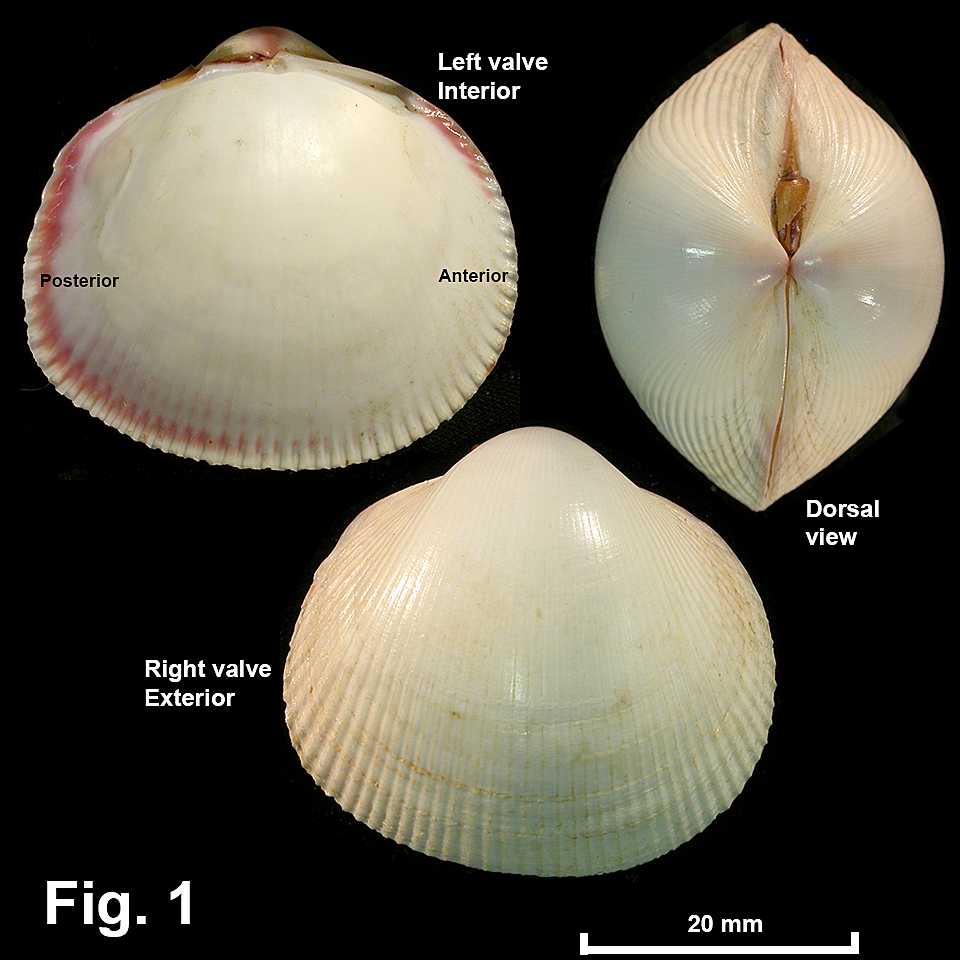
Fulvia tenuicostata (Lamarck, 1819) Description: Shell light in weight. Shape nearly circular, well inflated, length greater than height, weakly angled posteriorly, posterior more angled than anterior. Umbo slightly posterior to midline. Lunule and escutcheon wide. Exterior with about 50 small, rounded radial ribs with narrower interspaces; ribs absent from dorsal third or half of shell. Interior with exterior ribs showing through; anterior and posterior muscle scars distinct, pallial line continuous but indistinct. Margin crenulate by external ribs. Interior white with margin pink. Hinge wide with 2 small cardinal teeth and a large elevated lateral tooth each side. Ligament external, short. Shell white, umbones purple; covered with thin brown periostracum. Size: Up to 62 mm in length. Distribution: Port Stephens, NSW, southwards and around southern Australia, to Perth, WA, including Tas. Habitat: Lives in the shallow subtidal down to about 70 m depth in NSW. In SA, reported by Ludbrook (1984, p. 176) as living gregariously in sand and mud in 2-30 m depth. Often washed up on beaches. Common. Comparison: Fulvia aperta (Bruguière, 1789) and Fulvia australis (G.B. Sowerby II, 1834) are similar tropical species not found in NSW, differing in sculpture and colouration. Synonymy: Fulvia racketti (Donovan, 1825) is a previously recognised synonym. Fig. 1: Gunnamatta Bay, Port Hacking, NSW (C.64371) |
|