|
< Previous family introduction |
|
|||||
 |
Family Xenophoridae Carrier shells
|
|||||
|
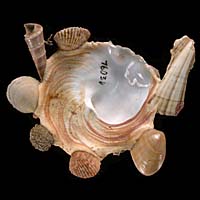
The Xenophoridae is a small family of remarkable molluscs that attach foreign objects to their shells. There are only 22 species in the family, living on the continental shelves or slopes of most tropical and temperate regions. They have medium to large, conical shell, with a small to large flange around the base, and in some species, short, blunt spines on the periphery. Two species are endemic to Australia; Xenophora peroniana is restricted to the east coast and X. flindersi to the south coast. Xenophorids attach a selection of solid objects of suitable size from those available on the substrate: complete or fragmentary bivalve and gastropod shells, pebbles, sections of coral, worm tubes or brachiopod shells. Each species has a preferred type and position of attached objects. X. peroniana attaches pebbles and bivalves shell most frequently, but also gastropods, worm tubes and corals, of size about equal to the whorl height. X. pallidula attaches bivalves initially, but on the last whorl attaches elongate shells such as terebrids and turrids in a radial manner. Other species, such as X. indica, appear to have given up the attachment habit and adhere only a few small fragments on the early whorls. Attachment of foreign objects to the shell is performed by the animal's mantle, a thin layer of tissue in contact with the internal shell surface, that grows the edge of the shell by secreting calcium carbonate in a protein matrix. To add a foreign object to the shell, the animal positions the object at the growing edge, holding it in place with foot and proboscis, and secretes calcium carbonate to cement it onto the growing edge of shell. The mode of life of xenophorids is arranged around prevention of detection. The animal, when it extends from the shell, lives within the enclosed space between the shell base and the substrate, fenced by the attached objects or the flange in wide-flanged species. The animal moves its shell in jerks, by planting the foot in the substrate and lifting the shell forward by about half a base diameter. Feeding occurs within the protective cage, by consuming microscopic algae or forams with the proboscis. Faeces are buried in a hole dug with the snout, a procedure which no doubt assists with preventing detection. There are six species known from NSW. The most common of these is Xenophora peroniana, which is endemic to eastern Australia. The other five species have an Indo-West Pacific distribution, reaching into NSW from the north to varying degrees; X. gigantea just reaches into northern NSW, but X. solarioides extends southwards to Batemans Bay. All of these five are uncommon to rare in the state. The other endemic species, X. flindersi, found in southern Australia, does not extend as far north as NSW. Family Reference Ponder, W.F. 1983. A revision of the recent Xenophoridae of the world and of the Australian fossil species (Mollusca: Gastropoda). Memoirs of the Australian Museum 17: 1-126. Kreipl, K. & Alf, A. 1999. Recent Xenophoridae. ConchBooks: Hackenheim, Germany. Coverage In addition to the species illustrated, the following species is recorded from NSW:
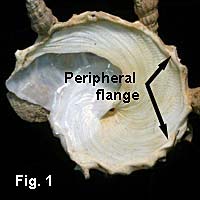
Identification Notes Shells are easily placed in this family because of the foreign matter attached to the shell. Identification of species relies on shell size and shape, especially the base shape, and the amount, type and position of foreign matter attached. The peripheral flange is an extension on the periphery of the last whorl that overhangs the base. This may be wide and well defined, as in Xenophota indica, or narrow and irregular as in most of the NSW species (Fig.1 4050-1). Because of the peripheral flange the shell base in xenophorids is concave overall, but the surface of the basal whorl, i.e. the surface between umbilicus and flange, may be flat, convex or concave. |
|||||
 |